Personalized Learning in India: How AI Can Help Students Learn at Their Own Pace
I watched a second-year student cry in a library once. Not dramatically. Not loudly. She had her face pressed into a 400-page textbook, highlighter still in her hand, and she was just… done. The semester exam was in nine days. She had attended every single lecture. Taken notes. Sat in the front row. And she still could not make sense of the material because her professor had covered fourteen chapters in the time her brain needed to truly absorb six. She was not a bad student. She was a mismatched one. This is the story that plays out across 53,000+ colleges and 1,400+ universities in India, every single semester. And I believe it is the most important problem in Indian higher education that almost nobody talks about with the urgency it deserves.
My name is Mr. Owl. I think about learning — not grades, not marks, not ranks — learning. And today, I want to walk you through something that research has proven for over four decades but Indian classrooms have barely begun to act on.
The One Number That Should Change Everything
In 1984, an educational psychologist named Benjamin Bloom published a study that shook the foundations of how we think about teaching. He found that students who received one-on-one tutoring along with mastery-based learning performed two standard deviations better than students taught in traditional classrooms. In plain language: the average tutored student outperformed 98% of students in a conventional classroom. Bloom called this the "2 Sigma Problem." Not because personalized instruction did not work — it clearly did — but because there was no practical way to deliver it to every student. There were not enough tutors, not enough hours, not enough money. For forty years, that problem sat unsolved. The proof existed. The solution did not scale. Every educator who read Bloom's paper understood the tragedy: we knew exactly what worked, we just could not afford to do it for everyone. Until now.
Why Indian College Students Need This More Than Anyone
India's higher education system is one of the largest on the planet. Nearly 580 million people are between the ages of 5 and 24. The Union Budget 2026-27 allocated ₹100 crore specifically for a Centre of Excellence in Artificial Intelligence for Education. The government sees it. The market sees it — the global AI in education market is projected to grow from $7 billion in 2025 to $136 billion by 2035. But let us forget the numbers for a moment and talk about what actually happens inside an Indian college classroom. A professor walks in. She has 70 students in a section. She has a syllabus designed by a university board that covers 60+ topics across a five-month semester. She lectures. Some students follow along. Some fall behind in week three and never catch up. Some are already ahead and spend lectures bored. The entire class moves at one speed — the professor's speed — regardless of whether that speed matches anyone's actual learning capacity. Research tells us that around 86% of Indian students experience high academic stress. Up to 70% report sleep difficulties during exam season. And the most painful part? Many of these students are not struggling because they lack ability. They are struggling because the system was never designed to meet them where they are. This is not a student failure. This is a design failure.
What Personalized Learning Actually Means (And What It Does Not)
Let me be specific, because "personalized learning" has become a phrase people throw around without definition. Personalized learning does not mean watching a YouTube video instead of attending class. It does not mean using ChatGPT to write your assignment for you. It does not mean an app that gamifies flashcards with confetti animations. Personalized learning means the content you study, the pace at which you study it, the depth of explanation you receive, and the way your understanding is assessed — all of these adapt to you. Your current knowledge level. Your gaps. Your strengths. Your upcoming exam schedule. Your actual syllabus. Benjamin Bloom's original research identified three conditions that made tutoring so effective: personalization (instruction adapted to the learner's pace), mastery learning (students fully understand a concept before moving forward), and continuous feedback (the learner knows exactly where they stand at all times). A recent randomized controlled trial published in Scientific Reports found that AI-powered tutoring outperformed traditional in-class active learning with an effect size between 0.73 and 1.3 standard deviations. That is not a marginal improvement. That is the kind of result that should make every college administrator sit up.
How AI Makes This Work in an Indian College Context
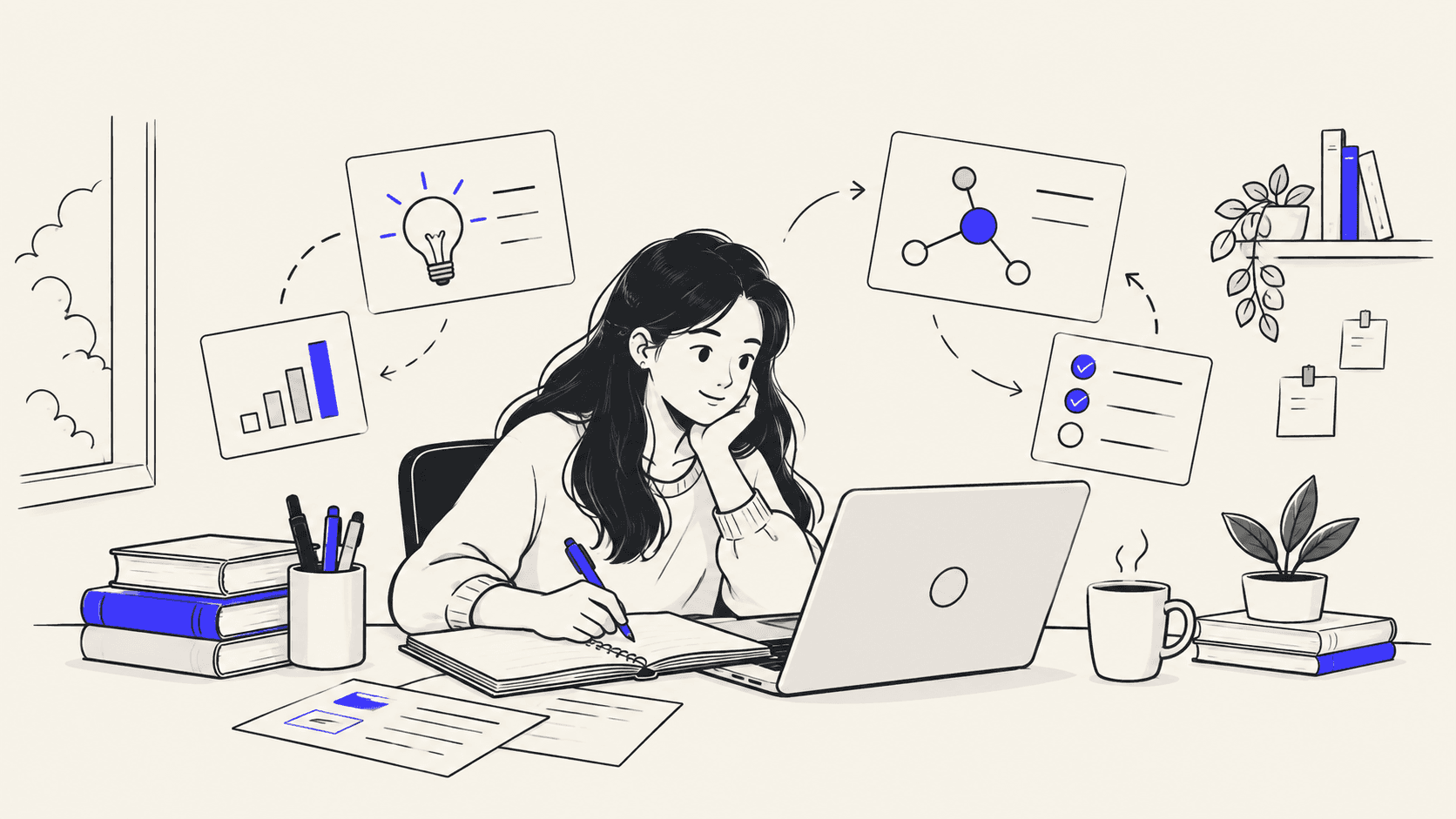
Here is where I need to be practical, because theory without application is just noise. Imagine this: You walk into your morning lecture. Your phone is in your pocket. An AI system is recording the lecture, filtering out the ambient noise of 70 classmates, and converting what your professor says into structured notes — organized by topic, mapped to your syllabus. After class, instead of flipping through 40 pages of a reference textbook to figure out what was important, you open your dashboard. The AI has already generated three versions of the notes: a quick summary for revision, a detailed version for deep understanding, and highlighted key terms that are likely to appear in your exam. But it goes further. The system knows which topics from last week you understood well and which ones you barely scraped through. It builds you a study plan — not a generic "study 2 hours daily" plan, but a specific roadmap that tells you: spend 40 minutes on Unit 3 Topic 7 today because your understanding is at a foundational level, then review Unit 2 Topic 4 briefly because you have already demonstrated application-level mastery there. This is what happens when you align AI with pedagogical frameworks like Bloom's Taxonomy — where learning is not binary (you either know it or you do not) but layered: remembering, understanding, applying, analyzing, evaluating, creating. A student who can recall a definition is at Level 1. A student who can apply that concept in a new scenario is at Level 3. The goal is not to test everyone the same way but to guide each student upward through their own learning levels. And when you get stuck? You do not wait until the next class or hunt through Reddit threads. You ask a doubt-solving assistant that actually knows your syllabus, your professor's reference material, and the context of what you have already covered. Not a generic AI that gives you a Wikipedia-level answer, but one that responds as if it has been sitting in your classroom beside you all semester.
The Research Is Clear. The Opportunity Is Now.
A 2026 study published in the Journal of Computer Science and Digital Technologies specifically examined AI-based personalized learning and student performance in Indian higher education. The findings reinforced what Bloom discovered four decades ago — personalization moves the needle on actual learning outcomes, not just engagement metrics. E-learning platforms that implement adaptive methods have been shown to improve knowledge retention by 25% to 60%, compared to roughly 8% to 10% for traditional classroom instruction alone. Online training with personalization elements can reduce the time needed to learn material by 40% to 60%. These are not projections. These are measurements. Meanwhile, the self-directed learning readiness research from Christian Medical College, Vellore found that Indian students' ability to take initiative in their own learning does not naturally improve over years of study unless the curriculum is designed to support it. In other words: you cannot just tell students to "study smarter." You have to give them systems that make smarter studying the default.
What Should You Look For in an AI Learning Tool?
If you are a student reading this, here is what I want you to ask before you trust any platform with your semester: Does it know your syllabus? A tool that does not understand your specific course plan is just a fancy search engine. Your AI should work within the boundaries of what your professor is actually teaching. Does it track where you actually are — not just what you have opened? There is a massive difference between "you viewed Topic 5" and "you demonstrated understanding of Topic 5 at the application level." The best systems track cognitive depth, not just clicks. Does it give you a study plan that adapts? Static plans break the moment you fall behind or skip ahead. A good system recalibrates weekly — maybe daily — based on your real progress and your real exam timeline. Does it connect to what happens in your classroom? Lecture capture, note generation, and doubt resolution should all tie back to the same course context. Disconnected tools create disconnected learning. Does it help you learn — or does it learn for you? This distinction matters more than anything else. If the AI is doing your thinking, it is hurting you. If the AI is showing you what to think about and giving you the structure to do it yourself, it is genuinely helping.
The Student Who Stopped Crying
I want to go back to that student in the library. Because this piece is not about technology for the sake of technology. It is about her. And the millions of students like her in Bengaluru, Delhi, Mumbai, Pune, Kolkata, Hyderabad, and every small-town college in between. She does not need a smarter textbook. She needs a system that recognizes she is a visual learner who grasps concepts through flowcharts better than paragraphs. She needs her 400-page syllabus broken into a sequence that matches her pace, not her professor's pace. She needs to know, on any given Tuesday, exactly what she should be studying and why — with evidence that she is getting stronger. Bloom proved that this kind of personalized, mastery-based instruction could take an average student and help them outperform 98% of their traditionally-taught peers. AI does not replace the tutor in this equation. It becomes the tutor that every student deserves but no institution could previously afford. The problem was never that students were not smart enough. The problem was that the system treated every student as if they were the same person. They are not. And now, finally, the technology exists to honor that truth.
Mr. Owl writes about learning, education technology, and student success for College Circle AI. Have a story about your own learning journey? We would love to hear it.